Trending

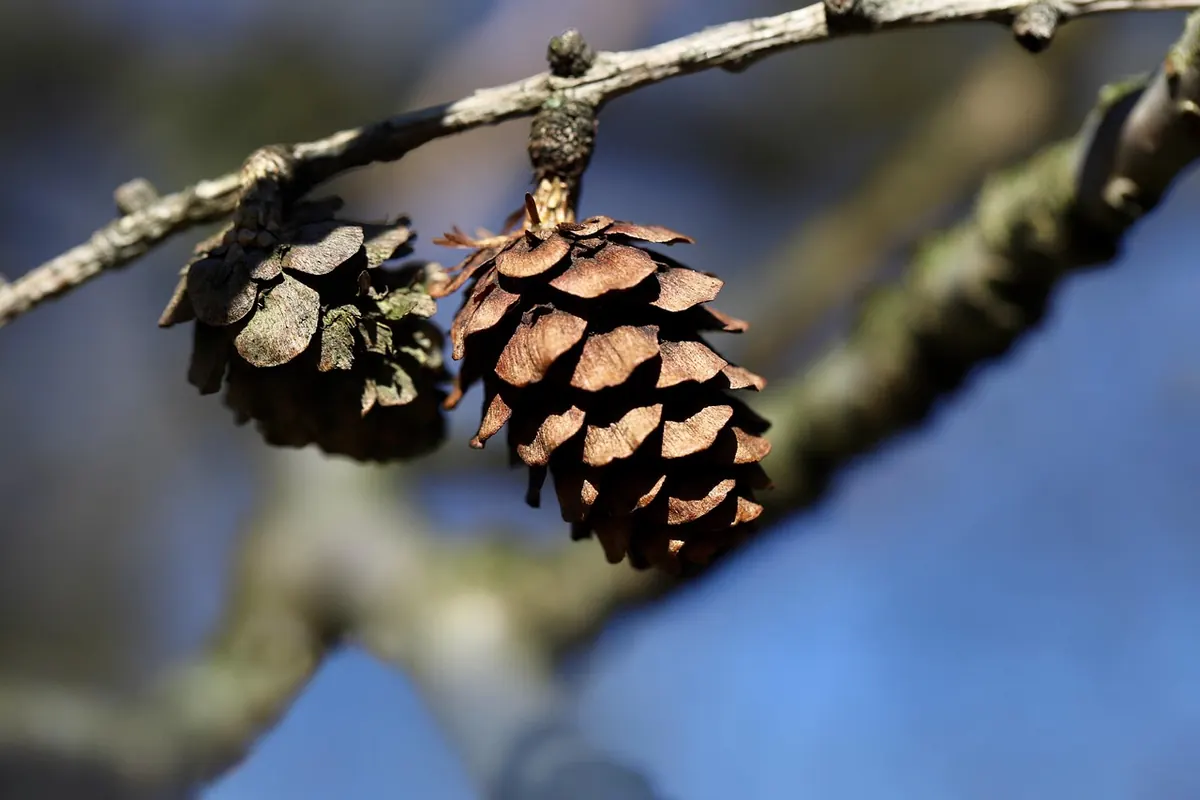
Stand in a larch plantation in late winter and the trees look much alike: bare, grey-brown, and strewn with old cones. Come back in June and you can separate European from Japanese larch in about ten seconds. The differences are consistent and easy to learn, which is useful when you are choosing what to plant — or trying to work out what is already growing at the bottom of the garden.
Both are deciduous conifers. Both were planted across Britain in enormous numbers for timber and shelter. But they want different ground, they grow at different speeds, and they are troubled by different diseases.
From spring onwards, the foliage gives the game away. European larch (Larix decidua) carries soft, light green needles around 2–3.5cm long, held in dense rosettes of roughly 30–40 on short, stubby shoots. The overall effect is fine, feathery and a little pale.
Japanese larch (Larix kaempferi) has longer needles, 3–5cm, and noticeably broader ones. Turn a shoot over and you will see two silvery-white bands of stomata underneath, giving a clear two-tone effect: blue-green above, silver beneath. The rosettes are denser too, often with 40 or more needles.
In autumn both turn gold, but Japanese larch usually colours a little later and holds its yellow longer. A mixed stand in late October often looks as though only half of it has turned.
Cones are the surest identifier, and they are on the tree for most of the year.
Small and egg-shaped, 2–4cm long, with scale edges that are straight or only gently wavy. They ripen brown in autumn, shed their seed, and usually fall or break up within a season or two, so the branches stay fairly clean.
Rounder and wider, 2–3.5cm, with scale edges that curl back sharply — like tiny spoons or a small rosette. They also persist on the twigs for years. A Japanese larch in January looks decorated with this year's cones, last year's and the year before that, held on noticeably longer stalks.
Current-year shoots of Japanese larch are reddish-brown with a bluish-grey bloom and a slightly hairy surface. European larch shoots are pale yellowish-brown to grey, hairless, and have none of that bloom.
European larch bark is grey-brown and becomes deeply fissured into scaly plates, giving mature trees a rugged, almost crusty look. The crown is narrow and spire-like, and the branches are fairly upright.
Japanese larch bark keeps a reddish-brown tone and stays smoother for longer, peeling in thin plates and strips rather than breaking into deep fissures. Its crown tends to be broader and more open, with branches that spread more horizontally. Two mature trees side by side are easy to tell apart on silhouette alone.
Both are fast growers. On reasonable ground you can expect 60–90cm of height a year, and more on a good site. Japanese larch is generally the quicker of the two, particularly on poorer ground.
Neither species belongs in a small garden. Both reach 25–35m with a spread of 8–12m or more, which rules out anything but a large plot, a field corner, a shelterbelt or a woodland edge.
Where you have the room, match the tree to the site. On a free-draining site with good air movement, European larch makes the better specimen, and moving air helps keep canker at bay. On heavy, wet or exposed ground, Japanese larch is the more practical choice, provided local plant health restrictions allow it.
Both give you autumn colour, winter light on the ground beneath them, and cones that feed red squirrels and seed-eating birds. Larch also supports a range of moths and other insects. Keep them well clear of drains, foundations, septic tanks and paving: these are big trees, and a mature larch needs generous space on all sides.
Where the two species grow near each other they cross, and the resulting hybrid — Larix × eurolepis, raised at Dunkeld in Perthshire in the early twentieth century — combines Japanese vigour with better resistance to canker. It is widely planted in Britain and sold by nurseries as Dunkeld larch or by its botanical name. Its cones fall between the parents in shape and often hold little viable seed. It is not immune to Phytophthora ramorum, so the same local restrictions apply.
Photo: Nennieinszweidrei / Pixabay