Trending

Larch is the odd one out among Britain's conifers. It is the only widely planted needle-bearing tree that sheds its needles each autumn, turning gold in October and standing bare through winter. That habit matters when you pick up a saw, because larch behaves differently from a leylandii or a yew. Cut one badly and it will not quietly grow back. Cut it well, at the right time, and it needs surprisingly little attention.
Most conifers in British gardens either tolerate hard cutting or resent it in predictable ways. Larch sits in a third category: it grows fast, it is generous with new growth on young wood, and it is stubbornly unforgiving about old wood. Once a branch has thickened and lost its needles, cutting back into it rarely produces fresh shoots. You get a bare stub that stays bare, and sometimes a pocket of decay behind it.
European larch (Larix decidua) and Japanese larch (Larix kaempferi) respond in broadly the same way, as does their hybrid. Japanese larch is the more susceptible of the two to Phytophthora ramorum, the disease behind large-scale felling in the wetter west of the UK, so tidy working habits around the tree are worth taking seriously.
Late winter is the sweet spot: mid-February through to early March, while the tree is still dormant and before the buds break. The sap is not moving, the tree is not spending energy on new needles, and any wound has a full growing season ahead of it to begin sealing over.
Avoid the damp, mild days of autumn. Fungal spores are about, larch canker is most active in that window, and a wet cut is slower to dry. Nor is mid-summer a good time for anything beyond light tidying.
Two other points on timing. Birds nest from roughly March to August, and larch, with its dense interior growth, is a popular site. It is an offence to disturb an active nest, so look before you cut if you are working in that window. And if your larch is covered by a Tree Preservation Order or sits in a conservation area, check with your local planning authority before starting work. Anything beyond routine pruning, particularly felling, may need a felling licence as well.
A young larch is straightforward to guide, and the work you do in the first fifteen years saves a great deal of trouble later.
Start with the leader. Larch grows with a strong central stem, but if the tip is damaged by wind, frost or a falling branch, the tree will throw two or three rivals. Choose the straightest and strongest and remove the others cleanly at their point of origin. Do not shorten them to a stub; that simply produces a fork.
Next, look for branches that cross, rub, or grow inwards towards the trunk. Take them out while they are still thin enough for secateurs.
Then resist the urge to clear the lower trunk. Those low branches feed the tree and thicken the stem. Removing them all at once leaves a thin, weak trunk and a larch that leans. Take off one or two of the lowest whorls a year, once they have begun to die back naturally, and no more.
A useful rule across all of this: never remove more than about a quarter of the live canopy in a single year.
The two jobs most people actually need to do are lifting low branches away from paths, drives and roofs, and taking out dead or broken wood.
Clearance should be done over several seasons, working upwards. Shorten a low branch by cutting back to a healthy side branch at least a third its thickness, or remove it entirely at the trunk. Either way, cut just outside the branch collar, the slight swelling where the branch meets the stem. Cutting flush with the trunk removes the tree's own protective tissue and leaves a wound that seals badly.
Deadwood is the exception to the timing rules. Dead, broken or hanging branches can come out at any time of year, and should, because they are a hazard rather than a benefit.
Keep an eye out for larch canker while you work. Look for sunken, resin-soaked patches on branches, often with dieback beyond them. Cut well behind the visible damage, into clean wood, and disinfect your tools before moving to the next tree. If a canker has reached the main trunk, take advice rather than attempting a rescue cut.
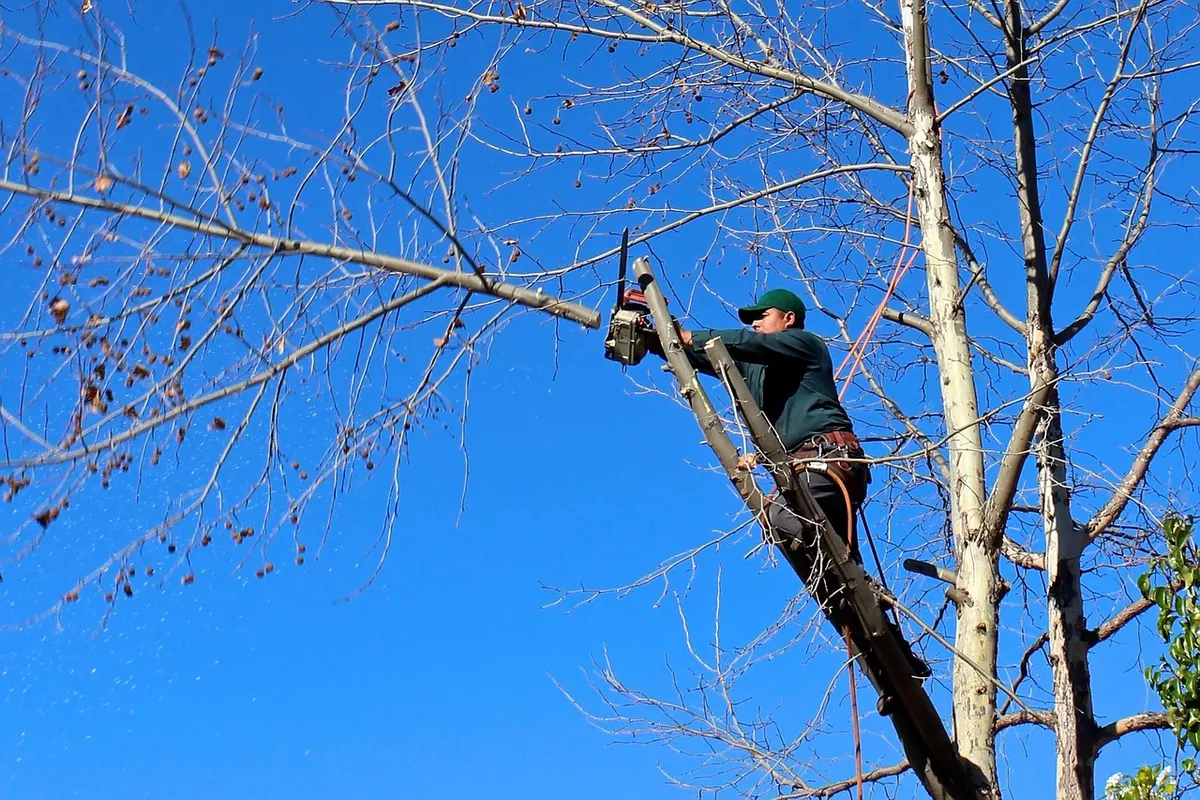
On heavier limbs, use the three-cut method: an undercut a little way out from the trunk, a top cut further along to bring the branch down, then a final clean cut at the collar. That stops the weight of the
Photo: nightowl / Pixabay